CBSE says students must study three languages from Class 9
CBSE introduces three-language rule for Classes 9 and 10 from July 1
- By Gurmehar --
- Sunday, 17 May, 2026
The Central Board of Secondary Education (CBSE) has announced a major change in the school curriculum for students of Classes 9 and 10. Starting from July 1, 2026, all CBSE-affiliated schools across India will follow the three-language rule for Class 9 students. The decision has been taken in line with the National Education Policy (NEP) 2020 and the National Curriculum Framework for School Education (NCF-SE) 2023.
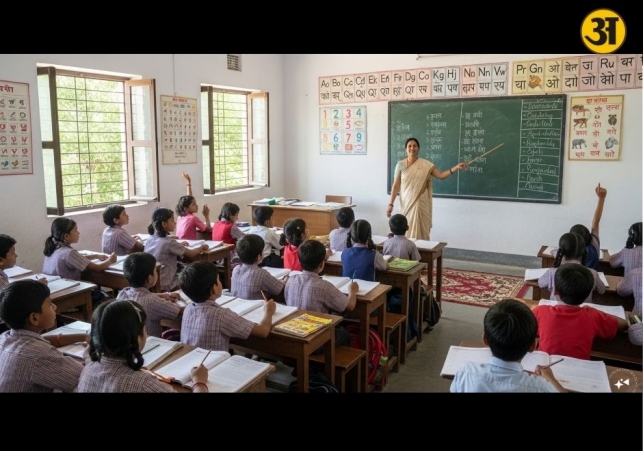
According to the new rule, students studying in Class 9 will have to study three languages. Out of these three languages, at least two must be Indian languages. CBSE says the policy is meant to promote multilingual learning and encourage students to stay connected with Indian languages and culture.
The board has clarified that the rule will first apply to students entering Class 9 from the academic session beginning July 2026. Over the next few years, the policy will gradually become fully operational for all secondary school students up to Class 10 by the academic year 2030-31.
The announcement has created discussions among students, parents and teachers. Many schools are now preparing to make changes in their timetables, teaching plans and language options to match the new guidelines.
CBSE said the new structure is not only about learning more languages but also about improving communication skills, cognitive ability and cultural understanding among students.
Under the new curriculum, languages will be divided into three groups known as R1, R2 and R3.
R1 will be the student’s primary language. This could be Hindi, English or another language chosen by the student according to school rules.
R2 will be another language different from the first one.
R3 will be the third language that students must study.
CBSE has clearly mentioned that the same language cannot be repeated at different levels. This means students cannot choose the same language for R1 and R2 together.
The board also said that India’s two official languages, Hindi and English, along with several regional and foreign languages, will continue to be offered in schools. According to the circular, students will have access to 42 languages, including all languages listed in the Eighth Schedule of the Indian Constitution.
This includes Indian regional languages such as Punjabi, Bengali, Tamil, Telugu, Marathi, Gujarati, Malayalam, Kannada and others. Some foreign languages may also continue to be available depending on the school.
CBSE believes the move will help students become more comfortable with India’s linguistic diversity. Officials say learning multiple languages can improve understanding, memory and communication abilities among children.
One important point clarified by CBSE is that there will not be a separate board examination for the third language in Class 10. This has brought some relief to students and parents worried about additional exam pressure.
ALSO READ: Xi warns US over Taiwan issue during Trump meeting in Beijing
ALSO READ: Russia plans to deploy powerful Sarmat nuclear missile by end of 2026
However, students will still need to study and pass the language during the school year according to school assessment rules.
Education experts say the move is part of a larger attempt to make school education more flexible and skill-based instead of focusing only on rote learning.
The National Education Policy 2020 had earlier recommended promoting multilingual education at the school level. The policy emphasised that children learn concepts better in familiar languages and should also remain connected to their local culture and heritage.
Supporters of the new rule say it may help preserve Indian languages that are slowly losing usage among younger generations.
At the same time, some parents have raised concerns about the extra academic load. They worry students already face heavy pressure because of competitive exams and multiple subjects.
Teachers and school administrators are also discussing how schools will arrange trained language teachers for multiple subjects, especially in smaller towns and rural areas.
Some schools may need to recruit additional teachers or redesign their schedules to fit the new system smoothly.
Apart from the language changes, CBSE has also announced another major academic reform for secondary students.
From the 2026-27 academic session, Mathematics and Science subjects will also move to a two-level system.
Under this system, students will first study the standard curriculum in Mathematics. There will be a common 80-mark examination lasting three hours.
In addition, students who wish to study advanced-level concepts will appear for a separate 25-mark paper designed to test higher-order thinking skills, also known as HOTS.
The new structure will replace the current Basic and Standard Mathematics system already followed in CBSE schools.
Science will also gradually adopt a similar two-level pattern.
CBSE says the aim is to give students more flexibility based on their learning abilities and career interests. Students interested in engineering, medical or technical fields may choose advanced learning, while others may continue with the standard level.
The first Class 10 board examinations under the new Mathematics and Science pattern are expected to be conducted in 2028.
Education experts believe these reforms show that India’s school education system is slowly moving toward more skill-focused and flexible learning methods.
Meanwhile, schools are waiting for further detailed guidelines from CBSE regarding implementation, teacher training and subject combinations.
Parents and students are also expected to receive more information from schools in the coming months regarding language options and examination patterns.
Despite mixed reactions, the three-language formula marks one of the biggest curriculum changes introduced by CBSE in recent years. Officials say the long-term goal is to create students who are academically strong, culturally aware and better prepared for future opportunities in a multilingual country like India.
Related News